Nietzsche's Final Teaching by Michael Allen Gillespie
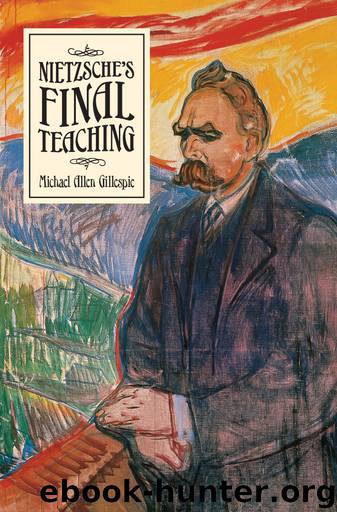
Author:Michael Allen Gillespie [Gillespie, Michael Allen]
Language: eng
Format: epub
ISBN: 978-0-226-47691-9
Publisher: University of Chicago Press
Published: 2017-06-14T04:00:00+00:00
WHAT DOES NIETZSCHE CONCEIVE HIMSELF TO BE?
In the preface of The Genealogy of Morals, published in 1887, Nietzsche asserts that, “We are unknown to ourselves, we men of knowledge—and with good reason. We have never sought ourselves—how could it happen that we should ever find ourselves?” He concludes with the admission that “we are necessarily strangers to ourselves, we do not comprehend ourselves, we have to misunderstand ourselves, for us the law ‘Each is furthest from himself’ applies to all eternity—we are not ‘men of knowledge’ with respect to ourselves” (KGW VI 2:259). Nietzsche here admits that he does not and indeed cannot understand himself. This stance hardly seems to provide a basis for an explanation of who he is. In Ecce Homo, however, Nietzsche does not attempt to tell us who he is. This work is not autobiographical or confessional. Nietzsche does not attempt to tell us about himself as an individual or as a member of the human species. His goal is rather to tell us how he became what he is, that is, what role he has come to play in the unfolding of events.10
But what does this mean? Dionysus is the god of ecstasy, of the orgiastic, of the dance; the god of tragedy and of music; the god of mania, of frenzy; the god of nighttime wisdom, of the abyss; the god who is born again every spring and repeatedly torn to pieces by his maenadic worshipers. He is thus the god of fecundity, and the inexhaustibility of life. But this god was already described in great detail in Nietzsche’s first work, The Birth of Tragedy. Does Nietzsche then imagine a simple rebirth of this god and of ancient piety here in his final work? This hardly seems likely and is actually belied by Nietzsche’s characterization of the god. In The Birth of Tragedy, Dionysus was conjoined with Apollo as the most potent of the two natural impulses at the basis of Greek art, which found its highest expression in Greek tragedy. Dionysus represented the contradictory primordial will, the infinite world-self, the deep abyss out of which, as Hesiod explained, the world came into being, but also the infinite pain of the great in vain that paralyzed the wills of Oedipus, Hamlet, and others, the impulse that found relief only in orgiastic festivals, and dwelled always behind masks. Apollo by contrast was the principium individuationis, the image of a single individual dissociated from the whole, the principle of order and form, and in tragedy the individualistic mask through which ordinary human beings were able to see and tolerate the Dionysian abyss.
In The Birth of Tragedy, both Apollo and Dionysus were contrasted to Socrates. Indeed, the death of tragedy and the disappearance of the spirit of music were attributed in large part to the advent of Socratic (and Euripidean) dialectic. This dialectical approach turned from the earlier reliance upon instinct to reason as the tool with which to understand existence and plumb its darkest depths. Suffering
Download
This site does not store any files on its server. We only index and link to content provided by other sites. Please contact the content providers to delete copyright contents if any and email us, we'll remove relevant links or contents immediately.
| Anthropology | Archaeology |
| Philosophy | Politics & Government |
| Social Sciences | Sociology |
| Women's Studies |
The remains of the day by Kazuo Ishiguro(8999)
Tools of Titans by Timothy Ferriss(8394)
Giovanni's Room by James Baldwin(7346)
The Black Swan by Nassim Nicholas Taleb(7129)
Inner Engineering: A Yogi's Guide to Joy by Sadhguru(6794)
The Way of Zen by Alan W. Watts(6614)
The Power of Now: A Guide to Spiritual Enlightenment by Eckhart Tolle(5781)
Asking the Right Questions: A Guide to Critical Thinking by M. Neil Browne & Stuart M. Keeley(5775)
The Six Wives Of Henry VIII (WOMEN IN HISTORY) by Fraser Antonia(5515)
Astrophysics for People in a Hurry by Neil DeGrasse Tyson(5189)
Housekeeping by Marilynne Robinson(4447)
12 Rules for Life by Jordan B. Peterson(4304)
Ikigai by Héctor García & Francesc Miralles(4274)
Double Down (Diary of a Wimpy Kid Book 11) by Jeff Kinney(4271)
The Ethical Slut by Janet W. Hardy(4251)
Skin in the Game by Nassim Nicholas Taleb(4248)
The Art of Happiness by The Dalai Lama(4130)
Skin in the Game: Hidden Asymmetries in Daily Life by Nassim Nicholas Taleb(4006)
Walking by Henry David Thoreau(3962)
